Solving the Fall Prevention Problem with Preemptive Intelligence
The primary benchmark for care quality is no longer just "what" we monitor, but "when" we intervene.
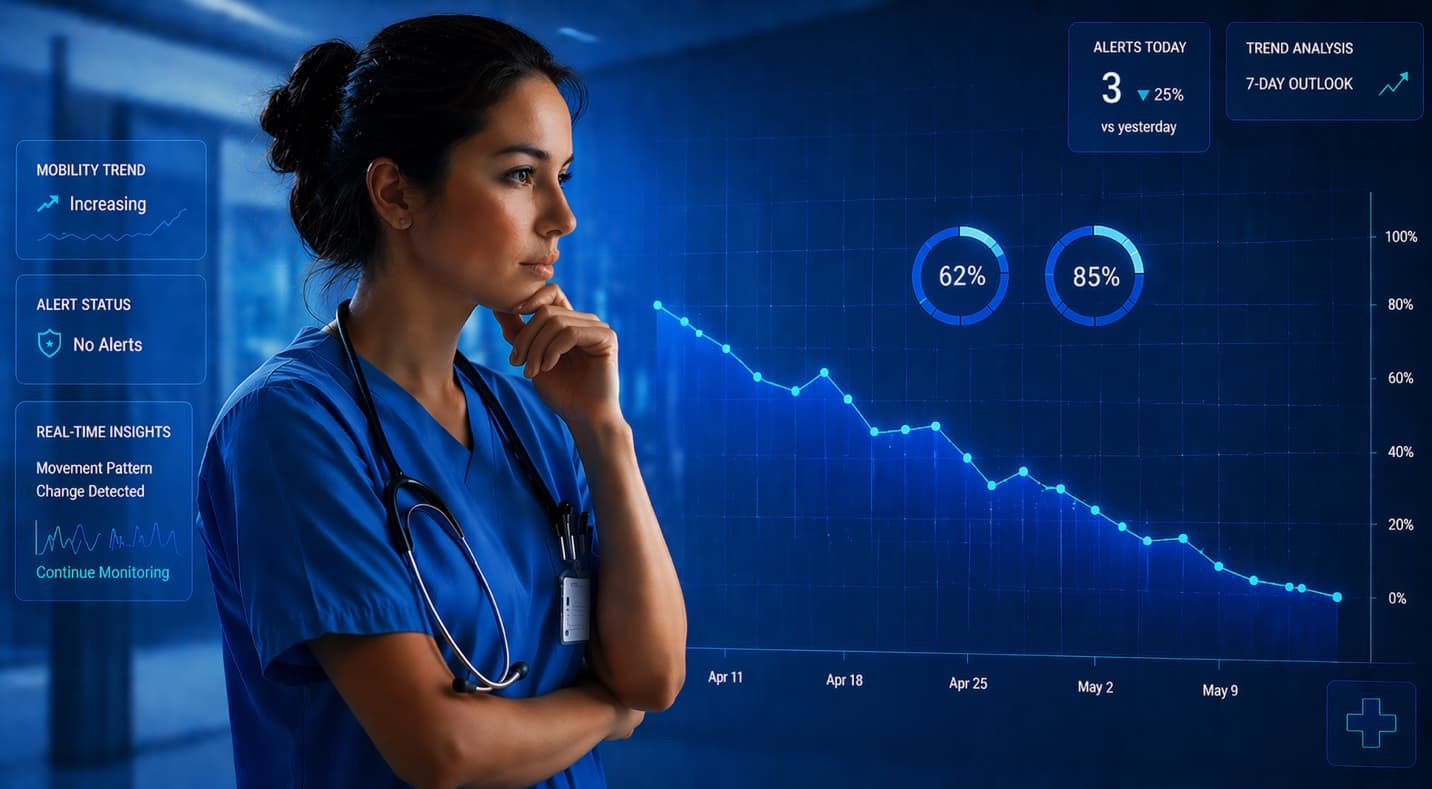
In the current healthcare landscape, patient safety is the primary benchmark for care quality in acute and post-acute facilities. Leading organizations, such as the World Health Organization (WHO) and the American Hospital Association (AHA), categorize safety as the top priority for healthcare providers across the care continuum. Yet, despite this focus, preventable "never events" remain a systemic challenge [1, 2]; falls and pressure injuries alone account for over 3.5 million preventable incidents annually [3, 4].
The industry is beginning to recognize that we don’t have a data problem—we have a response latency problem. While the physiological signals of an impending event are present, current protocols often fail to translate those signals into timely interventions.
The Costly Gap in Traditional Fall Prevention and Pressure Injury Protocols
Existing safety protocols often struggle because patient risk is inherently dynamic. Risk levels fluctuate based on pharmaceutical changes, blood pressure volatility, or post-surgical delirium. Even with validated tools like Johns Hopkins Fall Risk Assessment Tool (JHFRAT), Fall TIPS (Tailoring Interventions for Patient Safety), and the Braden Scale [5], a reliance on manual, point-in-time checks creates significant clinical gap.
These static assessments cannot bridge the gaps between nursing rounds, leading to several critical challenges:
- Alarm Fatigue
Alarm fatigue is not only about the number of alerts nurses receive. It is also about when those alerts arrive. Traditional bed sensor systems often notify staff after a patient has already shifted weight, moved toward the edge of the bed, or triggered a bed-exit condition. By then, the mobility sequence is already in motion. Nurses may receive another interruption, but not necessarily enough time to change the outcome. That is one reason studies of bed and chair alarms alone have shown mixed results in reducing inpatient falls.
- Direct Financial Impact
Beyond the physical toll, fall-related injuries average $35,000 per incident [8]. Severe Stage III/IV pressure injuries are even more costly, frequently exceeding $70,000 in hospital expenses per case.
- Nursing Burnout
Both falls and pressure injuries demand intensive post-care, investigations, and mandatory documentation. A single fall carries an estimated 15-hour "administrative burden" [9]. While specific time studies for pressure injuries are less common, we know they demand a relentless burden through two-hour repositioning cycles and intensive wound care management [10].
This is not a failure of monitoring; it is a failure of intervention timing.
Defining the Solution: OK2Predict
Definition: OK2Predict is a device and platform-agnostic AI engine that identifies physical movement patterns before adverse events occur. By processing real-time telemetry with sub-second latency, it transforms reactive monitoring into predictive alerting.
It operates as a Preemptive Intelligence Engine—a new layer of clinical infrastructure that sits between patient monitoring devices and care teams, converting patient data into actionable insights.
These insights surface directly within existing clinical workflows, enabling clinicians to act before high-risk movements result in patient harm.
To address these systemic failures, healthcare must move away from reactive "event detection" and toward preemptive intelligence. OK2Predict represents this transition by providing a hardware-agnostic AI service layer designed to identify physical movement patterns before an adverse event can occur. By integrating real-time telemetry (such as accelerometer data), the system identifies micro-behaviors that indicate a patient’s intent to sit up or stand.
- Low-Latency Processing: Inferences are processed in <200 ms.
- Preemptive Alerting Latency: With a total end-to-end latency of less than 6 seconds, the system provides a preemptive notification that allows clinicians to reach the bedside before a high-risk movement result in a fall.
Solving for Technical and Operational Scalability
A significant barrier to enterprise-wide safety is implementation friction. When safety tools require proprietary hardware or siloed platforms, they create a disruption in the care continuum. This manifests in three specific bottlenecks:
- The Integration Gap: Alerts frequently exist in vendor-specific dashboards rather than flowing directly into established EHR workflows, increasing cognitive load and introducing risk for clinical errors [11].
- Operational Complexity: Every piece of standalone hardware—proprietary beds, cameras, or monitors—introduces additional maintenance, charging, and training cycles [12].
- Capital Constraints: While a physical hospital bed has a high upfront cost, the true lifetime cost of a bed as part of the care delivery system can reach $2M–$6M [13]. High-cost proprietary infrastructure is financially unreachable for most healthcare systems.
A Device-and Platform-Agnostic Approach
By decoupling safety intelligence from specific physical hardware, health systems can transform safety into a software-defined service. This agnostic architecture leverages a facility's existing technology stack—from wearables to EHR data feeds—to drive real-time clinical inferences without the need for massive hardware replacement.
- Interoperability: Data moves seamlessly between EHRs and devices, ensuring alerts reach the right clinician at the right time.
- Data Composability: Real-time movement data can be combined with static tools like the JHFRAT or Braden Scale to create a more accurate, holistic patient risk profile.
Near Zero Fall Incident: A Case Study of Preemptive Alerts
To evaluate the efficacy of the OK2Predict preemptive model, a multi-site product assessment was conducted across four skilled nursing communities. Facilities identified a total of 31 high-fall-risk residents, aged 75 and older, who were monitored for more than 2,365 nighttime hours. During this evaluation, the AI functioned alongside existing fall prevention protocols, with nursing staff continuing their standard clinical workflows without disruption. To ensure data integrity, all alerts were visually verified in real-time by a dedicated evaluation team and confirmed by on-site nursing staff.
Key Performance Metrics:
- Near-Zero Fall Incidence: Only one fall occurred during the entire evaluation period, representing a 3.2% fall rate among a high-risk population.
- High Precision: 83.8% of generated alerts were verified as events requiring immediate staff attention.
- Actionable Intelligence: Unlike traditional sensors that produce high volumes of non-actionable noise, the predictive alerts were highly correlated with situations where staff intervention was appropriate.
- Reliability: System performance remained consistent across different facility types, regardless of variations in staffing levels or patient populations.
Conclusion: Reducing Preventable Events through Preemptive Timing
By shifting the focus from "what happened" to "what is about to happen," healthcare providers can finally address the timing problem. Moving toward a preemptive, software-defined. Safety model empowers clinicians to be in the right place at the right time—effectively reducing the incidence of preventable "never events" and allowing staff to focus on proactive, high-quality care.
If you would like to learn more about OK2StandUP dba OK2Predict, please contact us.

1. National Quality Forum (NQF)
Serious Reportable Events in Healthcare—2011 Update: A Consensus Report. Washington, DC: NQF; 2011.
2. The Joint Commission
Sentinel Event Data 2024 Annual Review.
3. Falls (Hospital Data) AHRQ PSNet Patient Safety Primer: Falls
Key Stat: This source confirms the 700,000 to 1,000,000 annual hospital falls.
4. AHRQ Toolkit: Preventing Pressure Injuries in Hospitals
Key Stat: This source confirms the 2.5 million patients affected annually and the associated costs/mortality.
5. Johns Hopkins Fall Risk Assessment Tool (JHFRAT)
6. Shorr RI, Chandler AM, Mion LC, et al.
Effects of an Intervention to Increase Bed Alarm Use to Prevent Falls in Hospitalized Patients: A Cluster Randomized Trial. Annals of Internal Medicine, 2012;157(10):692-699.
7. Sahota O, Drummond A, Kendrick D, et al. REFINE (Reducing Falls in In-patient Elderly)
Using bed and bedside chair pressure sensors linked to radio-pagers in acute hospital care: a randomised controlled trial. Age and Ageing, 2014;43(2):247-253.
8. Li S, Surineni K, Falls in Hospitalized Patients and Preventive Strategies
A Narrative Review, The American Journal of Geriatric Psychiatry Open Science, Education, and Practice, 2024; 5, 1-9
9. GCMS.gov Guidance for Performing Root Cause Analysis
AHRQ Patient Safety Network (PSNet) - Root Cause Analysis Primer
The Joint Commission - Sentinel Event Policy and Procedures
VA National Center for Patient Safety - RCA Tools
10. William V. Padula, Int Wound J. 2024
11. Westbrook JI, Woods A, Rob MI, Dunsmuir WTM, Day RO
Association of Interruptions With an Increased Risk and Severity of Medication Administration Errors. Arch Intern Med. 2010;170(8):683–690. doi:10.1001/archinternmed.2010.65
12. Shorr, R. I., et al. (2012)
"Steps to Prevent Falls in Hospitalized Patients: Randomized Controlled Trial." Annals of Internal Medicine.
A study proving that standard bed alarms (the "legacy defaults") do not significantly reduce fall rates. It proves that reactive sensors are not a safety solution.
13. Janke AT, Venkatesh AK. Understanding and Addressing the US Hospital Bed Shortage
JAMA Netw Open. 2025;8(2):e2460652. doi:10.1001/jamanetworkopen.2024.60652
Subscribe to our newsletter
We're committed to your privacy. OK2StandUP uses the information you provide to us to contact you about our relevant content, products, and services. You may unsubscribe from these communications at any time. For more information, check out our privacy policy.