

Beyond the Bed Alarm: A Granular ROI Analysis of Reclaiming Clinical FTE Capacity


Labor Cost of Inpatient Falls: Nursing Workload and Capacity
A patient fall creates immediate, uncompensated nursing work that disrupts care delivery and pulls staff away from other patients. This blog focuses on the incremental post-fall labor associated with each event and how preemptive intelligence can help recover clinical capacity and support workforce sustainability.
Estimate fall-related labor burden
Falls increase nursing work, documentation, LOS, and capacity strain.
Use the calculator to estimate the impact.
Operational Limitations of Reactive Fall Prevention
A Cochrane systematic review found that the effectiveness of commonly used fall prevention strategies in hospitals, including bed alarms, remains uncertain, with evidence rated as very low quality. Despite this, these interventions remain widely used, largely because they are easy to deploy and fit within existing clinical workflows.
Most traditional approaches to preventing patient falls are reactive by design. Alerts are triggered only after a patient has initiated movement, leaving a limited window for clinical response. In practice, this means that fall prevention systems often notify staff after risk has already materialized.
This timing gap creates operational challenges within hospital workflows. When a fall occurs, clinical teams must shift attention from ongoing care activities to assess and respond to the event. Because inpatient falls are classified as non-reimbursable events (“Never Events”) under current payment frameworks, these required care activities must be managed within existing clinical resources.
As a result, reactive fall prevention strategies do not fully align with how care is delivered in hospitals, where effective intervention depends on identifying risk early rather than responding after a fall has already occurred.
Extended Length of Stay: Sustained Clinical Labor Demand
Patients who experience a fall have substantially longer hospital stays compared to similar patients who do not. In a large case-control analysis, patients with a fall had a mean length of stay (LOS) of 15.0 days compared to 6.9 days for matched controls, representing an approximate 8-day increase associated with fall events (Dykes et al.).
Each additional day requires ongoing nursing care and monitoring, typically measured in nursing hours per patient day (NHPPD). Using a representative baseline of ~7.2 nursing hours per patient day, this LOS translates to approximately:
~35 to 40 additional hours of clinical labor per patient
Importantly, this labor is distributed across multiple shifts and care teams, making extended length of stay the primary driver of total clinical workload following a fall.
Post-Fall Clinical Workload: Concentrated Labor Demand
Based on our time-motion analysis using protocols from the Agency for Healthcare Research and Quality Tool 3O, Centers for Medicare and Medicaid Services, and The Joint Commission, a single fall event can add an estimated 5.0 to 7.0 hours of unplanned nursing work. This additional burden pulls staff away from other patients, interrupts workflow, and increases strain on already limited clinical capacity.
- Clinical & Neurological Monitoring (3.0 – 4.0 Hours): Clinical practice guidelines frequently dictate a high-frequency neurological evaluation cycle (starting at q15m) following a fall. This "interruption cycle" fragments the nurse’s shift, introducing cognitive load that prevents the delivery of "Top-of-License" care to the remainder of the patient cohort.
- Regulatory & "Defensive" Documentation (1.5 – 2.0 Hours): As CMS and private payers do not reimburse for "Never Events," documentation serves as a critical financial safeguard. Nurses must perform extensive HAC-08 Compliance reporting and EHR narrative charting to verify that prevention protocols were active prior to the event, mitigating the risk of total revenue penalties.
- Operational Coordination & Multi-disciplinary Huddles (0.5 – 1.0 Hours): Each incident triggers a mandatory post-fall huddle to identify root causes and update the care plan. While vital for systemic safety, this represents immediate operational overhead—labor costs that cannot be recouped from the payer.
Total Clinical Labor Impact: From Event to Workload
When a patient fall occurs, the impact extends far beyond the moment of the event. It creates a measurable demand on clinical time that accumulates across both immediate response and ongoing care.
Extended length of stay contributes approximately 35–40 hours of sustained nursing care, while post-fall activities—including monitoring, documentation, and coordination—add an additional ~5–7 hours of concentrated work. In total:
~42–44 hours of clinical labor demand per fall
For clinical teams, this is not abstract—it is time pulled from other patients, added to already complex workflows, and distributed across multiple shifts. As fall rates increase, this demand scales, contributing to workload strain and reduced flexibility in care delivery.
Clinical FTE ROI: Measuring Recoverable Clinical Time
We have created a Clinical FTE ROI framework that is powered by preemptive models such as OK2Predict, which translate patient physical activity data into actionable insights.
The ROI calculator model focuses specifically on incremental post-fall labor (~5–7 hours per event)—the work that is added on top of routine care—and excludes labor associated with extended length of stay, which reflects capacity utilization rather than new workload.
In addition, it excludes Sitter-related costs were not included in this analysis, as not all patients who experience falls are assigned sitters.
By isolating this incremental work, the model provides a clear estimate of recoverable clinical time.
Case Study: Clinical FTE ROI in a 1,000-Bed Hospital
Consider a 1,000 staffed bed hospital with approximately 50,000 annual patient discharges.
- Injurious fall rate: 0.3 per 1,000 discharges
- Non-injurious fall rate: 0.9 per 1,000 discharges
- Assumed reduction in falls: 35%
Based on these inputs, the modeled outcome shows:
Clinical FTE ROI: 0.08
This means the hospital would realize a reduction equivalent to 0.08 full-time clinical staff, driven by decreased time spent managing fall-related events (e.g., post-fall assessments, documentation, care coordination).
Important considerations:
· This estimate reflects clinical workflow efficiency gains only.
· Sitter-related costs are not included, as not all patients who experience falls are assigned sitters.
· As a result, this represents a conservative estimate of total economic impact.

Turn insight into impact
Quantify labor burden to support staffing, quality and finance
FAQ
What is the labor cost of an inpatient fall?
An inpatient fall creates both immediate post-fall work and longer-term care burden. The immediate work includes monitoring, documentation, huddles, and care coordination.
How many hours of nursing work does a fall add?
A single fall can add about 5–7 hours of incremental post-fall labor, excluding the additional work tied to extended length of stay.
Why is length of stay excluded from the ROI model?
Because it reflects ongoing capacity use rather than new event-driven workload. The ROI model is designed to measure recoverable clinical time.
What is preemptive fall prevention?
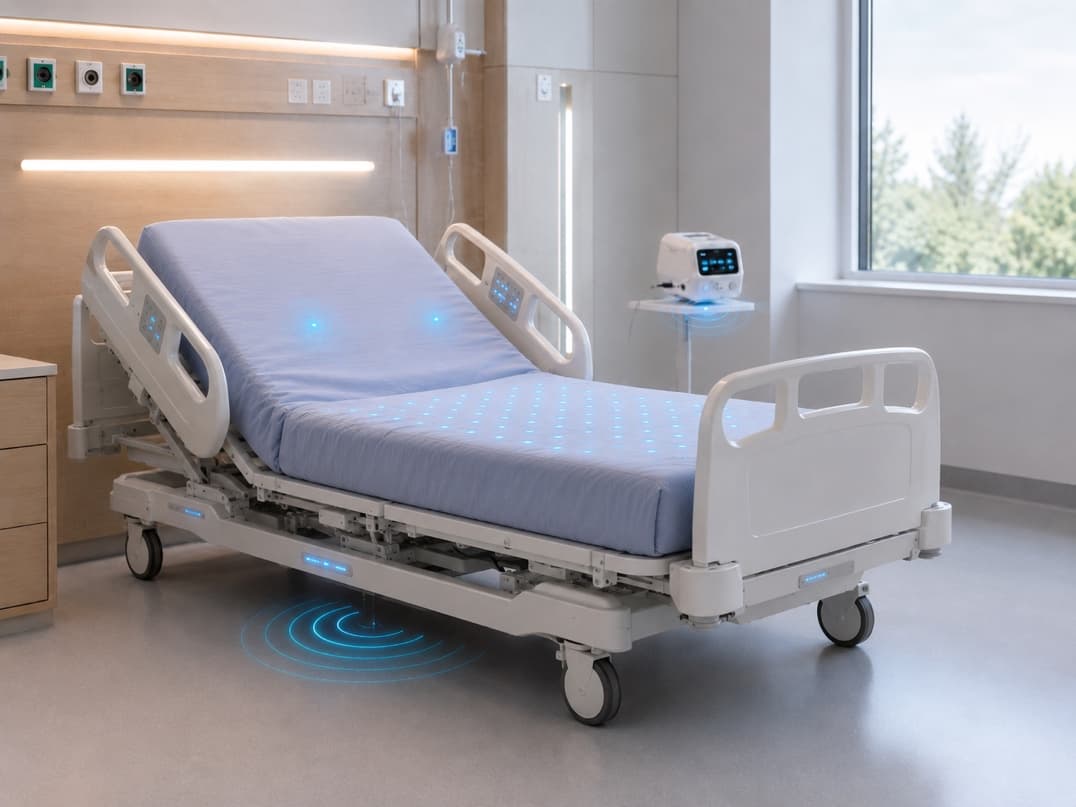
Preemptive fall prevention identifies risk before movement begins, giving staff more time to intervene and reduce interruptions
How does fall prevention improve nursing workload?
By reducing falls, hospitals can reduce post-fall monitoring, documentation, and coordination work, freeing nurses for other patients.

- Centers for Medicare & Medicaid Services (CMS). (2024). Medicare Program; Hospital Inpatient Prospective Payment Systems for Acute Care Hospitals and the Long-Term Care Hospital Prospective Payment System and Policy Changes and Fiscal Year 2025 Rates; Quality Programs and Medicare Promoting Interoperability Program Requirements for Eligible Hospitals and Critical Access Hospitals; etc. 89 Fed. Reg. 68986 (August 28, 2024). https://www.cms.gov/priorities/innovation/innovation-models/team-model
- ·Dykes PC, Curtin-Bowen M, Lipsitz S, et al. Cost of Inpatient Falls and Cost-Benefit Analysis of Implementation of an Evidence-Based Fall Prevention Program. JAMA Health Forum. 2023;4(1):e225125. doi:10.1001/jamahealthforum.2022.5125
- Cameron ID, Dyer SM, Panagoda CE, et al. Interventions for preventing falls in older people in care facilities and hospitals. Cochrane Database of Systematic Reviews. 2018;9:CD005465. doi:10.1002/14651858.CD005465.pub4
- National Quality Forum. (2026). 2025 Updates to Sentinel Events and Serious Reportable Events: Aligning Patient Safety Event Reporting. https://www.qualityforum.org/en-us/key-initiatives/updating-the-serious-reportable-events-sre-list
- Agency for Healthcare Research and Quality. Preventing Falls in Hospitals: A Toolkit for Improving Quality of Care. https://www.ahrq.gov/sites/default/files/publications/files/fallpxtoolkit_0.pdf
- CMS Falls with Major Injury (HAC-08) Specification: https://www.cms.gov/files/document/mids-just-fallsmajorinjury-508.pdf
- The Joint Commission. Sentinel Event Alert 55: Preventing falls and fall-related injuries in health care facilities. Published September 28, 2015. Accessed April 19, 2026. https://www.jointcommission.org/en-us/knowledge-library/newsletters/sentinel-event-alert/issue-55
- Centers for Medicare & Medicaid Services. Hospital Harm – Falls with Major Injury (eCQM CMS1017v2). 2024. Accessed April 19, 2026. https://ecqi.healthit.gov/ecqm/hosp-inpt/2026/cms1017v2
- Dunlay SM, Gullerud RE, Retelny AH, et al. Therapeutic and economic impact of fall-related injuries in hospitalized patients. Mayo Clinic Proceedings. 2011;86(12):1160-1166. doi:10.4065/mcp.2010.0766
- Vizient, Inc.; Nursa. 2025-2026 Workforce Productivity and Staffing Benchmark Report: Acute Care Nursing Trends. Irving, TX: Vizient, Inc.; 2025.
Related Blogs



Transform care through knowledge! Subscribe to our blog and keep up to date with advances in senior care.
We're committed to your privacy. OK2StandUP uses the information you provide to us to contact you about our relevant content, products, and services. You may unsubscribe from these communications at any time. For more information, check out our privacy policy.
