

How Wearable Motion Data Supports Hospital Fall-Risk Monitoring

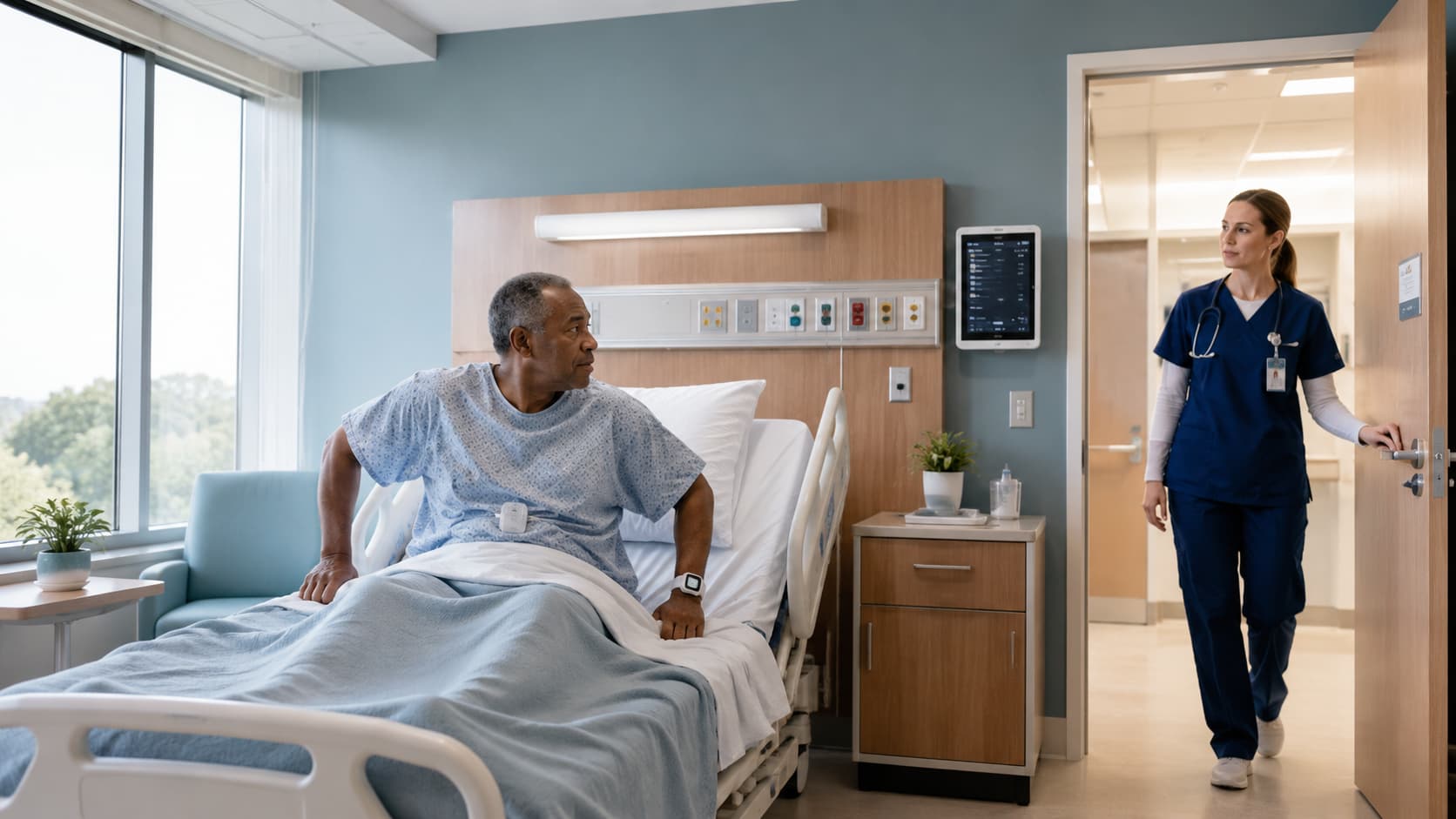
Wearable motion data is becoming more relevant to hospital fall-risk workflows because it can help care teams understand patient movement earlier in the mobility sequence. The practical value is not the wearable device itself. The value is whether motion data can be translated into useful, timely information that supports clinical staff.
Hospital fall-risk programs already include assessment, care planning, rounding, environmental safety measures, patient education, communication, and post-event review. Wearable movement alerts should be evaluated as one information source within that broader program, not as a replacement for clinical judgment or established protocols.
This distinction matters. A sensor may capture movement, but a hospital still has to decide whether the alert is timely, actionable, practical for nurses, acceptable to patients, and aligned with the organization’s fall-risk workflow.
Why hospitals need earlier awareness of patient movement
Fall risk in hospitals is dynamic. A patient’s status can change during a shift because of medication effects, toileting needs, pain, delirium, fatigue, postoperative weakness, diagnostic testing, or a desire to move without assistance. The Joint Commission has emphasized that patients in healthcare facilities may be at risk for falls because of clinical conditions and care processes that can leave them weakened or confused.
For that reason, hospitals cannot rely only on static risk scores or alerts that occur after a fall may already be underway. Care teams need signals that fit the timing of real patient movement. One clinically relevant moment is the transition from lying or resting in bed toward sitting up, because it may precede an attempted bed exit or other unassisted movement.
Wearable motion data can support this earlier awareness by detecting changes in body position, posture, and activity. The goal is not to treat every movement as urgent. The goal is to help staff distinguish routine movement from movement that may require attention.
What wearable motion data can and cannot show
A body-worn motion sensor can measure movement patterns such as changes in orientation, acceleration, posture, and activity. Depending on the device design and algorithm, those signals may help identify when a patient is shifting position, beginning to sit up, or moving in a way that may require staff awareness.
Wearable data can be useful because it follows the patient rather than the bed. Bed-based systems may detect a change in pressure or position at the bed surface. Room-based systems may detect motion in the environment. A wearable sensor can provide information from the patient’s body movement itself.
At the same time, wearable data has limits. It does not replace assessment. It does not remove the need for rounding, toileting support, medication review, environmental checks, or individualized care planning. Hospitals should evaluate wearable alerts based on whether they add useful context without adding unnecessary alarm burden.
How wearable movement alerts differ from fall detection
Traditional fall detection focuses on recognizing that a fall may have occurred or is already underway. That can be useful in some care settings, especially when the goal is rapid notification after an event. But for hospital fall-risk workflows, the more useful question is often whether staff can receive earlier awareness before a patient reaches a higher-risk moment.
Wearable movement alerts shift the focus from detecting the fall event to recognizing earlier movement that may require staff response. For example, a patient beginning to sit up from a lying position may be an important signal when the patient is known to be at risk for unassisted movement.
This does not mean every sit-up attempt is unsafe. It means the signal may be clinically useful when interpreted in context: the patient’s fall-risk status, mobility level, medication profile, care plan, staffing workflow, and response protocol.
Why alert design matters
A fall-risk technology can fail operationally even if the sensor works. If alerts are too frequent, too late, too nonspecific, or disconnected from nursing workflow, they may increase alarm fatigue rather than improve response.
Hospitals should therefore evaluate alert design as carefully as sensor capability. Useful questions include:
· Does the alert occur early enough to support staff response?
· Is the alert specific enough to avoid unnecessary response burden?
· Does the alert fit the communication tools nurses already use?
· Can staff quickly understand why the alert matters?
· Does the alert support the existing fall-risk protocol rather than creating a separate process?
AHRQ’s hospital fall-prevention resources emphasize risk assessment, tailored care planning, implementation support, communication, and measurement. Wearable motion data should support those functions rather than stand apart from them.
Privacy and workflow considerations
Hospitals evaluating movement-monitoring technologies often have to balance patient safety, privacy, workflow, and staff adoption. Video monitoring may provide visual context, but it can also raise privacy questions and require human observation capacity. Bed-exit alarms are familiar but may alert later in the movement sequence.
Wearable motion data offers a different approach. It can provide movement-based awareness without continuous video observation. That may be useful for hospitals that want earlier patient movement signals while limiting visual monitoring in the care environment.
The tradeoff is operational. Wearables must be applied correctly, charged or maintained, cleaned according to policy, assigned to the right patient, and integrated into staff workflows. These practical requirements should be part of the evaluation, not afterthoughts.
Implementation considerations for hospitals
Before adopting wearable movement alerts, hospitals should evaluate both clinical fit and operational feasibility. A structured review should include:
· Patient selection: Which patient groups are appropriate for wearable movement alerts?
· Alert thresholds: Which movements should trigger staff awareness?
· Response workflow: Who receives the alert, and what is the expected response?
· Alarm burden: How will the team monitor non-actionable alerts?
· Device operations: How will devices be applied, cleaned, charged, and tracked?
· Protocol alignment: How does the system support existing fall-risk interventions?
· Measurement: What metrics will the hospital track before and after implementation?
These questions help prevent a common technology problem: adding another alerting layer without clearly defining its role in the care process.
Regulatory and claims considerations
Wearable movement-alert technology should be described carefully. For FDA Class I / PJO positioning, the safest language is centered on monitoring, alerts, signals, staff awareness, and workflow support. Language that implies autonomous diagnosis, treatment, guaranteed fall prevention, or replacement of clinical protocols should be avoided unless specifically supported and cleared for that use.
A conservative description is that wearable motion data can support earlier awareness of patient movement and notify trained staff when movement may require response. The technology should be positioned as an adjunct to established fall-risk workflows, not as a standalone fall-prevention program.
Bottom line
Wearable motion data can be useful in hospital fall-risk monitoring when it improves timing, context, and workflow fit. The question is not whether a device can generate more data. The question is whether the data helps care teams recognize meaningful patient movement earlier and respond within established clinical processes.
For clinicians and hospital leaders, the evaluation should stay practical: Is the alert clinically relevant? Does it reduce uncertainty or add noise? Does it support nursing workflow? Can it be implemented reliably? Those questions matter more than whether the technology is described as wearable or AI-enabled.
FAQ
What are fall-prevention wearable devices?
Fall-prevention wearable devices are body-worn sensors that monitor patient movement and activity patterns. In hospital fall-risk workflows, these devices can help care teams recognize movement signals that may require staff awareness, such as a patient beginning to sit up or attempting unassisted movement.
How are wearable movement alerts different from fall detection devices?
Fall detection devices typically alert after a fall may have occurred or is already underway. Wearable movement alerts are designed to notify care teams earlier in the patient movement sequence, such as when a patient demonstrates sit-up intent or another movement pattern that may require attention.
Why does wearable placement matter in fall-risk monitoring?
Wearable placement affects the quality and usefulness of movement data. A sensor placed on the body can capture changes in posture, activity, and movement patterns that may not be visible to bed-based alarms or room-based systems alone.
How can wearable motion data support nursing workflows?
Wearable motion data can support nursing workflows by providing earlier awareness of patient movement that may require staff response. The goal is not to create more alarms, but to provide timely, actionable information that fits into existing clinical workflows.
Do wearable movement alerts replace clinical fall-risk protocols?
No. Wearable movement alerts should support established clinical fall-risk protocols. They are not a substitute for nursing assessment, rounding, care planning, environmental safety measures, or clinical judgment.

1. The Joint Commission. Sentinel Event Alert 55: Preventing falls and fall-related injuries in health care facilities. https://www.jointcommission.org/en-us/knowledge-library/newsletters/sentinel-event-alert/issue-55
2. Agency for Healthcare Research and Quality. Fall TIPS: A Patient-Centered Fall Prevention Toolkit. https://www.ahrq.gov/patient-safety/settings/hospital/fall-tips/index.html
3. Agency for Healthcare Research and Quality. Preventing Falls in Hospitals: A Toolkit for Improving Quality of Care. https://www.ahrq.gov/sites/default/files/publications/files/fallpxtoolkit.pdf
4. FDA Product Classification: Product Code PJO, Fall Prevention Alarm/Sensor Combination Attached or Unattached. https://www.accessdata.fda.gov/scripts/cdrh/cfdocs/cfPCD/classification.cfm?ID=PJO
5. eCFR. 21 CFR 880.2400 - Bed-patient monitor. https://www.ecfr.gov/current/title-21/chapter-I/subchapter-H/part-880/subpart-C/section-880.2400
6. Cochrane. Interventions designed to reduce falls in older people in hospitals. https://www.cochrane.org/evidence/CD016065_how-effective-are-interventions-designed-reduce-falls-older-people-hospitals
Related Blogs


Transform care through knowledge! Subscribe to our blog and keep up to date with advances in senior care.
We're committed to your privacy. OK2StandUP uses the information you provide to us to contact you about our relevant content, products, and services. You may unsubscribe from these communications at any time. For more information, check out our privacy policy.
